01
Commercial spaces
August 2026
August 2026
Turnkey planting for commercial interiors
Why a coherent approach outperforms one-off plant purchases — and how planting becomes an architectural material in its own right.


Blossom Lab ARCHIVE
7 MIN READ
Not decoration, but architecture of experience
omprehensive landscaping is not about buying a few plants or searching for "something green" at the last moment before the facility opens. It is part of the overall impression architecture.
01 · Context
C
which affects how the space is perceived, how a person moves through it, what they remember, and how cohesive the interior seems.
When an office, restaurant, hotel, sales office, or public space is designed with a botanical layer in mind from the very beginning, plants begin to function as a full‑fledged material. They zone the open space, soften the strict geometry, create focal points, enhance the depth of the lobby, and make the space warmer or, conversely, more status‑oriented and graphic. To achieve this, landscaping should stem from the purpose of the space, not from a random selection of decor.
We are not designing a set of plants, but a botanical scenario for the space.
“
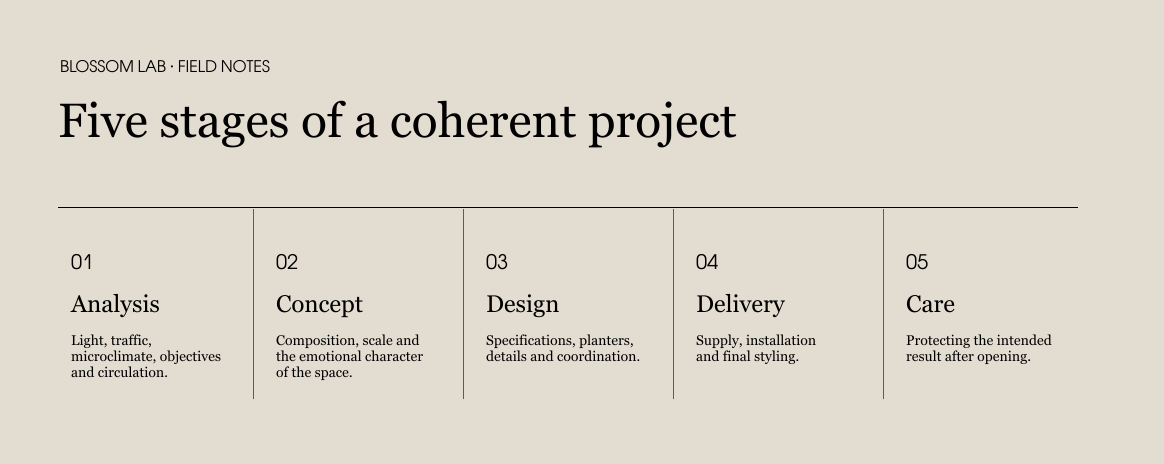
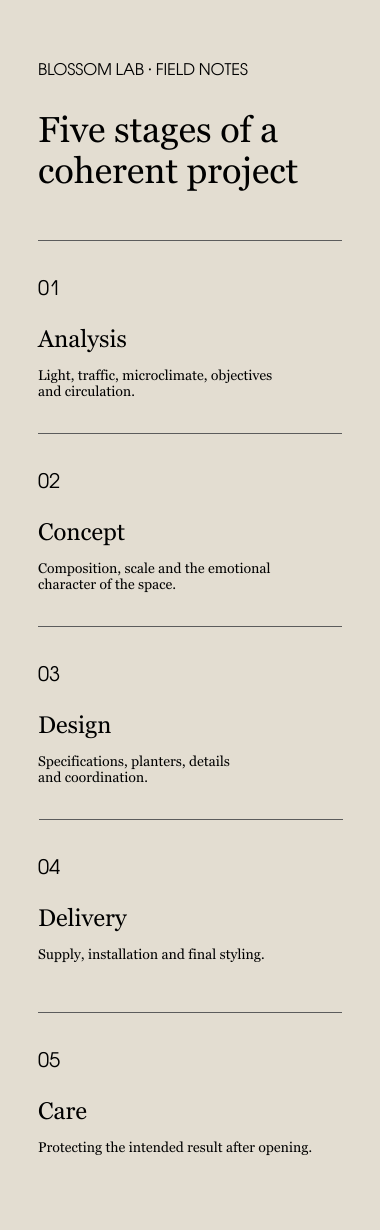
02 · Analysis
Begin with questions about the space
A comprehensive approach begins with questions. Who will be using the space? What kind of lighting is there? How intense is the traffic? Is there a team ready to take care of it? What kind of image does the space need: natural, minimalist, striking, gallery‑style, intimate, or brand‑oriented? Where should people stop and look, and where should they move through quickly?
It is these questions that determine whether the project will feature live plants, artificial botanical replicas, stabilized elements, or a combination of these.

The botanical layer supports architectural rhythm and visitor circulation.
Blossom Lab
03 · Concept
A botanical scenario instead of a product list
At the concept stage, it’s important not just to select plant species, but to develop a botanical scenario for the space. Where will there be major accents? Where is a rhythm of repeating planters needed? Where do hanging compositions work best, or is a green wall appropriate? In which areas is it better to abandon living plantings in favor of artificial or stabilized solutions?
A good concept immediately takes into account aesthetics and future use. The proportions of the plants, the shape of the planters, the density of the composition, and the color of the greenery are all connected to the materials, furniture, and lighting.
04 · Realization
Documentation, installation and life after opening
After the concept, the project moves on to documentation and implementation. For a commercial facility, this is especially important: landscaping must be linked to the construction schedule, installation logistics, finishing materials, lighting, engineering, and operational rules. Otherwise, even a striking idea may turn out to be inconvenient or short‑lived.
That is precisely why comprehensive turnkey landscaping outperforms "point‑by‑point purchases." The client receives not a set of disparate elements, but a coordinated system: an idea, visualization, material selection, supply, installation, decoration, and, if necessary, maintenance. For businesses, this means less chaos, fewer losses due to rework, and a stronger final result. For designers and architects, it means a reliable partner who understands how to integrate plants into a project at a professional level.

Good planting feels inherent to the space — which is why it continues to work over time.
Blossom Lab
Good landscaping doesn’t look like a temporary layer. It seems like a natural part of the space — and that’s precisely why it lasts a long time.
02
Next story
Three plant materials


Write to us
© All rights reserved.