02
Materials
August 2026
August 2026
Living, artificial and preserved plants for interiors
The strengths and limits of each material — and why the best interiors rarely rely on one solution alone.


Blossom Lab archive
6 min read
There is no universal answer
01 · Selection
ne of the most common questions at commercial and private properties is: what is better — live, artificial, or stabilized plants? There is no universal answer, because each solution has its own purpose, its own resource, and its own usage scenario.
O
Professional selection doesn’t start with a catalog, but with the specific conditions of the area in question: the amount of light, the ease of maintenance, the required service life, the scale of the composition, and the emotional effect that the person should experience.
The right choice depends not on fashion, but on the task.
“
02 · Living
Natural movement and demanding beauty
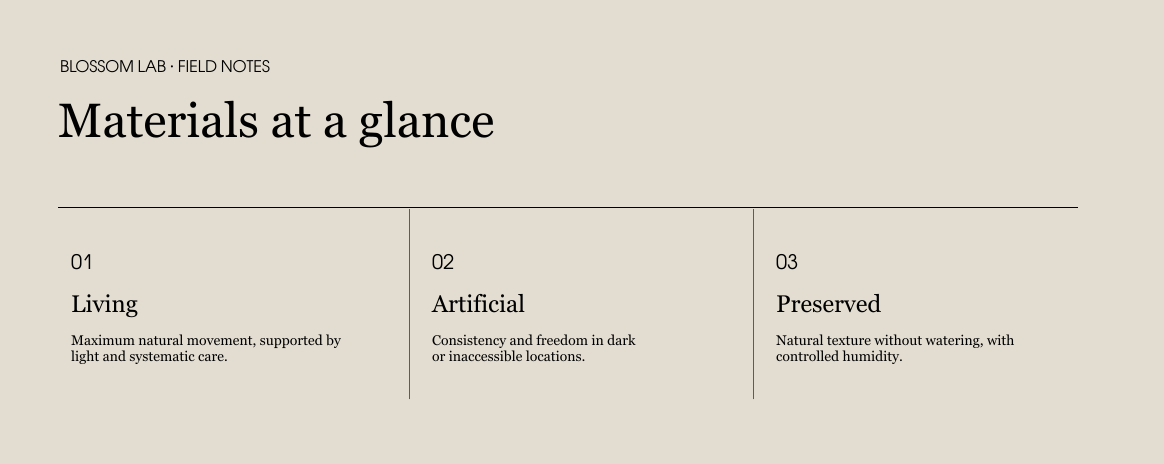
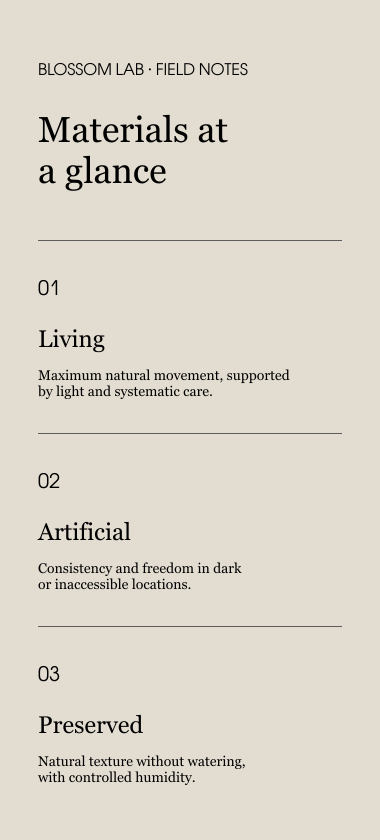
Live plants are chosen when the project requires genuine natural dynamics. They transform the space not only visually but also emotionally: they create a sense of life, season, softness, and depth.
However, living plants require conditions — proper lighting, careful selection of species, thoughtful care, and regular maintenance. If the object is not ready for this reality, even an attractive planting will quickly lose its quality.
03 · Artificial
Stability for complex scenarios
Artificial plants are a solution for situations where the stability of appearance is important, where complex installation scenarios are required, where there is a lack of natural light, or where there are limitations on watering or access for maintenance.
Modern botanical replicas make it possible to assemble three‑dimensional compositions, impressive trees, dense phytosols, and hanging elements, as well as large decorative accents. For restaurants, lobbies, photo zones in public spaces, and high‑traffic facilities, this is often the most rational choice.

In demanding commercial zones, material stability becomes part of project quality.
Blossom Lab
04 · Stable
Natural texture without classic care
Stabilized plants occupy an intermediate position and retain their natural texture, but they do not require traditional care, watering, or sunlight. At the same time, it is important not to attribute to them properties that they do not have. For example, materials about stabilized moss include an important clarification: this is a decorative material, and it is not advisable to attribute to it air purification or humidity regulation as a commercial argument.
Its real advantages are its expressive natural texture, the lack of need for regular maintenance, and the long‑lasting decorative effect when used under proper conditions.
05 · Combination
The strongest projects usually use a mix
In practice, the best projects rarely rely on a single type of material. A mix works much better. In a pass‑through area or a hard‑to‑reach location, you can use an artificial solution. In a key vantage point — live plants. For a branded wall, an accent panel, or a complex decorative composition — stabilized elements. This combined approach allows you to assemble the space beautifully, logically, and without operational mistakes.
The right choice always depends not on fashion, but on the task at hand. If you value living, natural plasticity and are ready to take care of it, choose live landscaping. If the priority is resource, stability, and complex decorative scenarios, artificial solutions may be more effective. If you need a natural visual effect without classic maintenance, stabilized materials will do.
A professional approach begins where, instead of imposing a single option on the subject, an optimal combination is selected to suit the real‑life context of the space.
03
Next story
Partnering with Blossom Lab


Write to us
© All rights reserved.